openmaterials.ai / codes / Materials Project API
mp-api: query the Materials Project database of computed properties
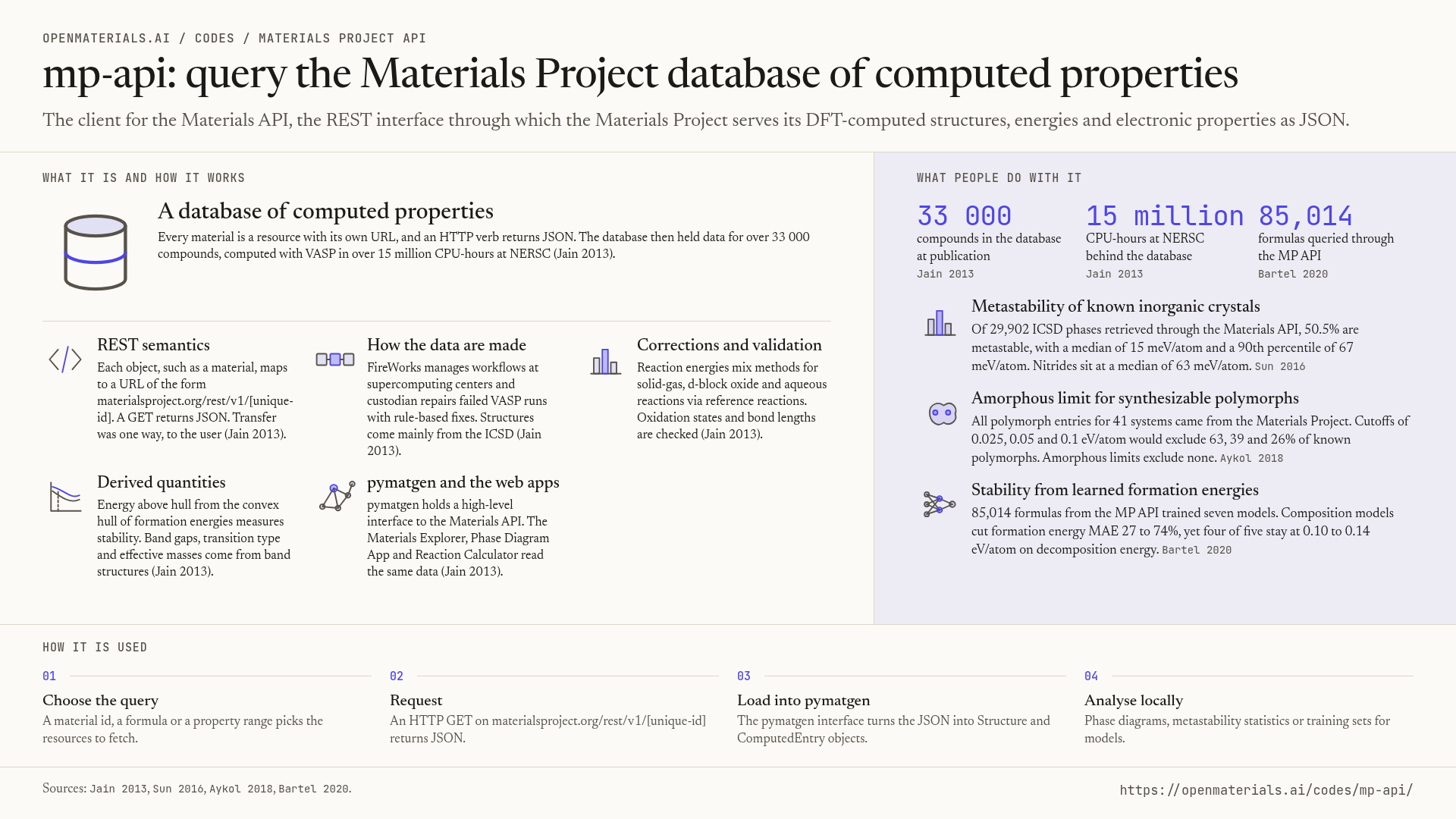
The client for the Materials API, the REST interface through which the Materials Project serves its DFT-computed structures, energies and electronic properties as JSON.
What it is and how it works
A database of computed properties
Every material is a resource with its own URL, and an HTTP verb returns JSON. The database then held data for over 33 000 compounds, computed with VASP in over 15 million CPU-hours at NERSC (Jain 2013).
REST semantics
Each object, such as a material, maps to a URL of the form materialsproject.org/rest/v1/[unique-id]. A GET returns JSON. Transfer was one way, to the user (Jain 2013).
How the data are made
FireWorks manages workflows at supercomputing centers and custodian repairs failed VASP runs with rule-based fixes. Structures come mainly from the ICSD (Jain 2013).
Corrections and validation
Reaction energies mix methods for solid-gas, d-block oxide and aqueous reactions via reference reactions. Oxidation states and bond lengths are checked (Jain 2013).
Derived quantities
Energy above hull from the convex hull of formation energies measures stability. Band gaps, transition type and effective masses come from band structures (Jain 2013).
pymatgen and the web apps
pymatgen holds a high-level interface to the Materials API. The Materials Explorer, Phase Diagram App and Reaction Calculator read the same data (Jain 2013).
What people do with it
- 33 000compounds in the database at publicationJain 2013
- 15 millionCPU-hours at NERSC behind the databaseJain 2013
- 85,014formulas queried through the MP APIBartel 2020
Metastability of known inorganic crystals
Of 29,902 ICSD phases retrieved through the Materials API, 50.5% are metastable, with a median of 15 meV/atom and a 90th percentile of 67 meV/atom. Nitrides sit at a median of 63 meV/atom. Sun 2016
Amorphous limit for synthesizable polymorphs
All polymorph entries for 41 systems came from the Materials Project. Cutoffs of 0.025, 0.05 and 0.1 eV/atom would exclude 63, 39 and 26% of known polymorphs. Amorphous limits exclude none. Aykol 2018
Stability from learned formation energies
85,014 formulas from the MP API trained seven models. Composition models cut formation energy MAE 27 to 74%, yet four of five stay at 0.10 to 0.14 eV/atom on decomposition energy. Bartel 2020
How it is used
Choose the query
A material id, a formula or a property range picks the resources to fetch.
Request
An HTTP GET on materialsproject.org/rest/v1/[unique-id] returns JSON.
Load into pymatgen
The pymatgen interface turns the JSON into Structure and ComputedEntry objects.
Analyse locally
Phase diagrams, metastability statistics or training sets for models.
What Materials Project API is
mp-api is the Python client for the Materials Project, the database of computed properties for inorganic materials. It returns structures, energies above hull, band gaps, elastic tensors and other stored quantities by material id or by query. On the map it serves the quantities it retrieves. It computes none of them.
WebsiteRepositoryOn the mapAll codesLicense: modified BSD (BSD-3-Clause)
In more detail
What the Materials Project stores and how it is made
The project computes properties of known inorganic compounds, mostly ICSD structures, with VASP. FireWorks runs the workflows at supercomputing centers and custodian repairs failed runs by rule-based fixes to cluster and convergence parameters, so a metal and an insulator get different workflows without human steps. At publication the database held over 33 000 compounds from over 15 million CPU-hours. Automated checks compare oxidation states, cell volumes and bond lengths with experiment and flag outliers, van der Waals layered compounds for instance, and a Report Issues button collects user corrections (Jain 2013).
The Materials API
The API follows REST principles. Each material is a URL such as materialsproject.org/rest/v1/[unique-id], an HTTP verb acts on it, and the answer is JSON. The project launched it so that users could pull large datasets for data mining or combine local data with the project's, which the web apps cannot serve efficiently. At the time transfer was one way, with two-way submission of structures and experimental data planned. pymatgen carries a high-level interface to the API, and pymatgen-db builds local Materials Project-like MongoDB databases (Jain 2013).
Studies built on the API
Sun 2016 retrieved 29,902 provenance-filtered ICSD phases and found 50.5% metastable with a median of 15 meV/atom and a 90th percentile of 67 meV/atom. Aykol 2018 took every polymorph entry in the database for 41 systems and compared them with ab initio amorphous limits. Bartel 2020 queried all entries with formation enthalpy below 1 eV/atom on July 26, 2019 through the MP API, 85,014 formulas, and noted that the decomposition energies used for training and testing change as new stable materials enter the database.
What it computes on the map
13 quantities, drawn by tier with the data flow between them. Dashed boxes are intermediate quantities. Select one for its formula and the other codes that compute it.
Embed this submap
<iframe src="https://openmaterials.ai/m/c56731602651/0400000000000118ede0?embed=1" title="Materials Project API on the OpenMaterials map" width="100%" height="480" loading="lazy" style="border:1px solid #EBEBEB;border-radius:6px"></iframe>
Each quantity with the interface the representation records.
- BandGapmpr.materials.summary.search(fields=['band_gap']).band_gap, eV; also bs.get_band_gap()['energy'] from the electronic-structure endpointev
- BulkModulusmpr.materials.elasticity.search().bulk_modulus.vrh, GPa (nested {voigt, reuss, vrh} dict)GPa
- DielectricTensormpr.materials.summary.search(fields=['e_electronic']).e_electronic, dimensionless (electronic dielectric constant)dimensionless
- ElasticConstantsmpr.materials.elasticity.search().elastic_tensor.{raw, ieee_format} (Voigt 6x6), GPaGPa
- EnergyAboveHullmpr.materials.summary.search(fields=['energy_above_hull']).energy_above_hull, eV/atom; also mpr.materials.thermo.search(thermo_types=[...])ev_per_atom
- FormationEnergympr.materials.summary.search(fields=['formation_energy_per_atom']).formation_energy_per_atom, eV/atomev_per_atom
- MagneticMomentmpr.materials.magnetism.search().magmoms[i] (per-site list, mu_B); MagnetismDoc.magmomsmu_B
- PoissonRatiompr.materials.elasticity.search().homogeneous_poisson, dimensionlessdimensionless
- ShearModulusmpr.materials.elasticity.search().shear_modulus.vrh, GPa (nested {voigt, reuss, vrh} dict)GPa
- Structurempr.materials.summary.search(fields=['structure']).structure / mpr.materials.get_structure_by_material_id(material_id) -> pymatgen Structure, angstrom
- SurfaceEnergympr.materials.summary.search(fields=['weighted_surface_energy']).weighted_surface_energy, J/m^2 (Wulff-weighted aggregate)J_per_m2
- Voltagempr.materials.insertion_electrodes.search(working_ion=...).average_voltage, Vvolt
- YoungsModulusmpr.materials.elasticity.search().young_modulus, SI Pa (DIVIDE by 1e9 for GPa)Pa
References
The code
The papers that describe the code; cite them when you use it.
- A. Jain, S. P. Ong, G. Hautier et al., Commentary: The Materials Project: A materials genome approach to accelerating materials innovation, APL Materials, 2013. doi.org/10.1063/1.4812323
Applications
Highly cited studies that cite the code, with a few picked by hand.
- W. Sun, S. T. Dacek, S. P. Ong et al., The thermodynamic scale of inorganic crystalline metastability, Science Advances, 2016. doi.org/10.1126/sciadv.1600225
- M. Aykol, S. S. Dwaraknath, W. Sun et al., Thermodynamic limit for synthesis of metastable inorganic materials, Science Advances, 2018. doi.org/10.1126/sciadv.aaq0148
- C. J. Bartel, A. Trewartha, Q. Wang et al., A critical examination of compound stability predictions from machine-learned formation energies, npj Computational Materials, 2020. doi.org/10.1038/s41524-020-00362-y
How to cite
A. Jain, S. P. Ong, G. Hautier, et al., Commentary: The Materials Project: A materials genome approach to accelerating materials innovation, APL Mater. 1, 011002 (2013)