openmaterials.ai / codes / ORCA
ORCA: quantum chemistry for molecules, from DFT to multireference methods
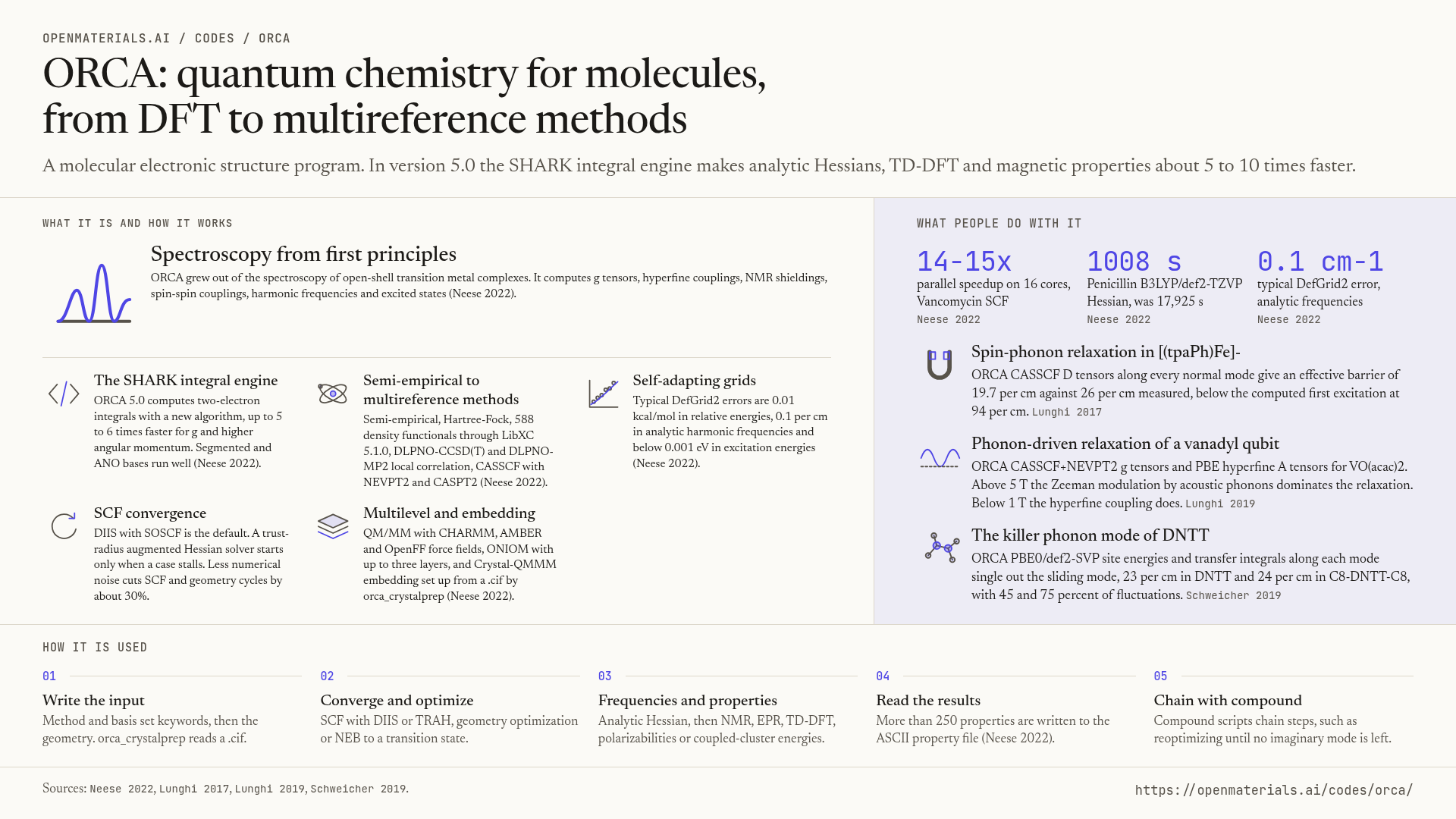
A molecular electronic structure program. In version 5.0 the SHARK integral engine makes analytic Hessians, TD-DFT and magnetic properties about 5 to 10 times faster.
What it is and how it works
Spectroscopy from first principles
ORCA grew out of the spectroscopy of open-shell transition metal complexes. It computes g tensors, hyperfine couplings, NMR shieldings, spin-spin couplings, harmonic frequencies and excited states (Neese 2022).
The SHARK integral engine
ORCA 5.0 computes two-electron integrals with a new algorithm, up to 5 to 6 times faster for g and higher angular momentum. Segmented and ANO bases run well (Neese 2022).
Semi-empirical to multireference methods
Semi-empirical, Hartree-Fock, 588 density functionals through LibXC 5.1.0, DLPNO-CCSD(T) and DLPNO-MP2 local correlation, CASSCF with NEVPT2 and CASPT2 (Neese 2022).
Self-adapting grids
Typical DefGrid2 errors are 0.01 kcal/mol in relative energies, 0.1 per cm in analytic harmonic frequencies and below 0.001 eV in excitation energies (Neese 2022).
SCF convergence
DIIS with SOSCF is the default. A trust-radius augmented Hessian solver starts only when a case stalls. Less numerical noise cuts SCF and geometry cycles by about 30%.
Multilevel and embedding
QM/MM with CHARMM, AMBER and OpenFF force fields, ONIOM with up to three layers, and Crystal-QMMM embedding set up from a .cif by orca_crystalprep (Neese 2022).
What people do with it
- 14-15xparallel speedup on 16 cores, Vancomycin SCFNeese 2022
- 1008 sPenicillin B3LYP/def2-TZVP Hessian, was 17,925 sNeese 2022
- 0.1 cm-1typical DefGrid2 error, analytic frequenciesNeese 2022
Spin-phonon relaxation in [(tpaPh)Fe]-
ORCA CASSCF D tensors along every normal mode give an effective barrier of 19.7 per cm against 26 per cm measured, below the computed first excitation at 94 per cm. Lunghi 2017
Phonon-driven relaxation of a vanadyl qubit
ORCA CASSCF+NEVPT2 g tensors and PBE hyperfine A tensors for VO(acac)2. Above 5 T the Zeeman modulation by acoustic phonons dominates the relaxation. Below 1 T the hyperfine coupling does. Lunghi 2019
The killer phonon mode of DNTT
ORCA PBE0/def2-SVP site energies and transfer integrals along each mode single out the sliding mode, 23 per cm in DNTT and 24 per cm in C8-DNTT-C8, with 45 and 75 percent of fluctuations. Schweicher 2019
How it is used
Write the input
Method and basis set keywords, then the geometry. orca_crystalprep reads a .cif.
Converge and optimize
SCF with DIIS or TRAH, geometry optimization or NEB to a transition state.
Frequencies and properties
Analytic Hessian, then NMR, EPR, TD-DFT, polarizabilities or coupled-cluster energies.
Read the results
More than 250 properties are written to the ASCII property file (Neese 2022).
Chain with compound
Compound scripts chain steps, such as reoptimizing until no imaginary mode is left.
What ORCA is
ORCA is an electronic structure package for molecules: DFT, coupled cluster, multireference and spectroscopic methods, with frequency and property calculations. It is free for academic use under its own license. On the map it serves the molecular quantities it computes.
WebsiteOn the mapAll codesLicense: Proprietary (ORCA: free for academic use; commercial license via FACCTs)
In more detail
Electronic structure methods
ORCA covers semi-empirical methods, Hartree-Fock, DFT with LDA, GGA, meta-GGA, hybrid, double-hybrid and range-separated functionals, and wavefunction methods for single and multireference problems (Neese 2022). Local correlation uses pair natural orbitals in large domains. This family includes DLPNO-CCSD(T) with F12 for open shells, DLPNO-MP2 analytic second derivatives for polarizabilities and NMR shieldings, and DLPNO-STEOM coupled cluster for excited states. CASPT2 and NEVPT2 were reformulated to avoid the four-particle density, next to DLPNO-NEVPT2-F12 and a fully internally contracted MRCCSD. Solvation enters through CPCM and SMD, up to coupled-cluster energies.
Numerics and scale
Version 5.0 rebuilt the integral layer around SHARK, a C++ engine up to 5 to 6 times faster than traditional algorithms for high angular momentum integrals. SHARK now drives analytic Hessians, TD-DFT and response properties about 5 to 10 times faster than before (Neese 2022). RIJCOSX is the default for hybrid functionals. On 16 cores of an AMD EPYC 7302 machine the Fock builds for Vancomycin (176 atoms) ran 14 to 15 times faster than on one core, and about 25 times on 32 cores. The B3LYP/def2-TZVP analytic Hessian of Penicillin (42 atoms) fell from 17,925 s in ORCA 4.2.1 to 1008 s. The new grids are 2 to 4 times larger than the old defaults, but integration still scales linearly.
Licensing and interfaces
ORCA is free of charge for academic users and sold to industry through FAccTs, with more than 40,000 registered academic users and a manual of over 1300 pages (Neese 2022). The compound scripting language automates protocols such as reoptimizing along an imaginary mode until a true minimum is found, and exposes more than 250 properties through the ASCII property file. QM/MM reads CHARMM, AMBER and OpenFF force fields, ONIOM nests up to three layers, and Crystal-QMMM embeds a cluster in converged point charges.
Validation
The grid incompleteness errors of DefGrid2 are 0.01 kcal/mol in relative energies (0.05 with COSX), 0.1 per cm in analytic harmonic frequencies (0.04 with COSX) and below 0.001 eV in excitation energies, and DefGrid3 cuts them by a further factor 2 to 5 (Neese 2022). With the new grids the RIJCOSX results are nearly indistinguishable from fully analytic exchange. In the application papers, ORCA CASSCF D tensors give [(tpaPh)Fe]- an effective barrier of 19.7 per cm against a measured 26 per cm (Lunghi 2017). The computed relaxation time of VO(acac)2 starts to converge to experiment above 5 T (Lunghi 2019).
What it computes on the map
5 quantities, drawn by tier with the data flow between them. Dashed boxes are intermediate quantities. Select one for its formula and the other codes that compute it.
Embed this submap
<iframe src="https://openmaterials.ai/m/c56731602651/00000000000000c000000068?embed=1" title="ORCA on the OpenMaterials map" width="100%" height="480" loading="lazy" style="border:1px solid #EBEBEB;border-radius:6px"></iframe>
Each quantity with the interface the representation records.
- Forcesminus the Cartesian energy gradient of an ORCA EnGrad run, Hartree/bohr (served in eV/A)eV_per_A
- HOMOLUMOGapLUMO minus HOMO energy from the ORBITAL ENERGIES block of the ORCA output, eVev
- MolecularFrequencyVIBRATIONAL FREQUENCIES block of the ORCA output, cm^-1, imaginary modes printed negative, with IR intensities in km/mol from the IR SPECTRUM blockinverse_cm
- ReactionBarrier[construction=neb_mep]E(TS) - E(reactant) from two ORCA total energies, the TS a saddle with exactly one imaginary modeev
- TotalEnergyFINAL SINGLE POINT ENERGY in the ORCA output, Hartree (served in eV)ev
References
The code
The papers that describe the code; cite them when you use it.
- F. Neese, The ORCA program system, WIREs Computational Molecular Science, 2011. doi.org/10.1002/wcms.81
- F. Neese, Software update: the ORCA program system, version 4.0, WIREs Computational Molecular Science, 2017. doi.org/10.1002/wcms.1327
- F. Neese, F. Wennmohs, U. Becker et al., The ORCA quantum chemistry program package, The Journal of Chemical Physics, 2020. doi.org/10.1063/5.0004608
- F. Neese, Software update: The ORCA program system: Version 5.0, WIREs Computational Molecular Science, 2022. doi.org/10.1002/wcms.1606
Applications
Highly cited studies that cite the code, with a few picked by hand.
- A. Lunghi, F. Totti, S. Sanvito et al., Intra-molecular origin of the spin-phonon coupling in slow-relaxing molecular magnets, Chemical Science, 2017. doi.org/10.1039/C7SC02832F
- A. Lunghi, F. Totti, R. Sessoli et al., The role of anharmonic phonons in under-barrier spin relaxation of single molecule magnets, Nature Communications, 2017. doi.org/10.1038/ncomms14620
- G. Schweicher, G. D'Avino, M. T. Ruggiero et al., Chasing the “Killer” Phonon Mode for the Rational Design of Low‐Disorder, High‐Mobility Molecular Semiconductors, Advanced Materials, 2019. doi.org/10.1002/adma.201902407
- A. Lunghi, S. Sanvito, How do phonons relax molecular spins?, Science Advances, 2019. doi.org/10.1126/sciadv.aax7163
How to cite
F. Neese, Software update: The ORCA program system, Version 6.0, WIREs Comput. Mol. Sci. 15, e70019 (2025)