openmaterials.ai / codes / ShengBTE
ShengBTE: the phonon Boltzmann equation solved by iteration
A Fortran and MPI solver that takes second- and third-order force constants and iterates the linearized phonon BTE to convergence with adaptive broadening and no free parameters.
What it is and how it works
Full iterative solution
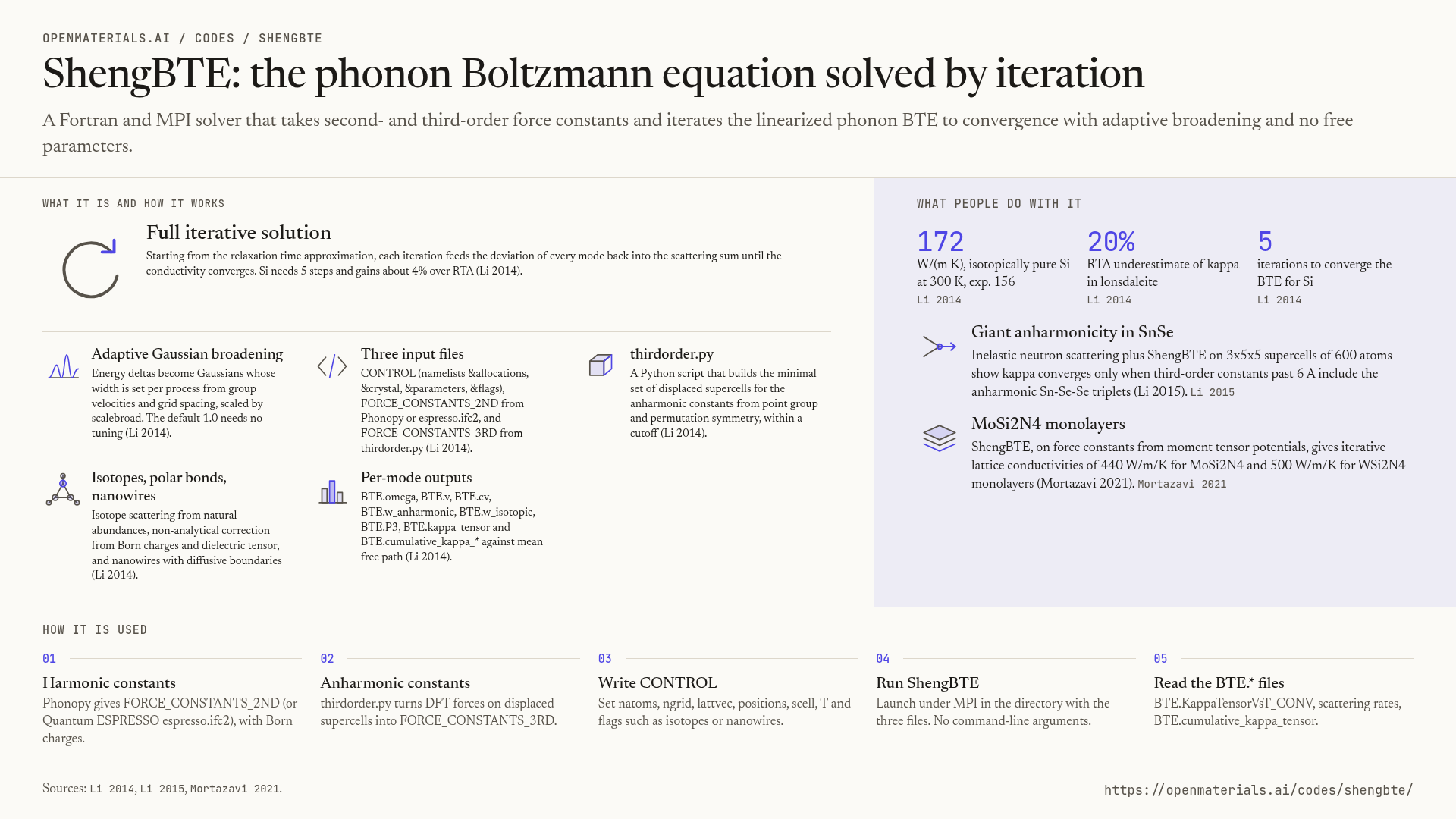
Starting from the relaxation time approximation, each iteration feeds the deviation of every mode back into the scattering sum until the conductivity converges. Si needs 5 steps and gains about 4% over RTA (Li 2014).
Adaptive Gaussian broadening
Energy deltas become Gaussians whose width is set per process from group velocities and grid spacing, scaled by scalebroad. The default 1.0 needs no tuning (Li 2014).
Three input files
CONTROL (namelists &allocations, &crystal, ¶meters, &flags), FORCE_CONSTANTS_2ND from Phonopy or espresso.ifc2, and FORCE_CONSTANTS_3RD from thirdorder.py (Li 2014).
thirdorder.py
A Python script that builds the minimal set of displaced supercells for the anharmonic constants from point group and permutation symmetry, within a cutoff (Li 2014).
Isotopes, polar bonds, nanowires
Isotope scattering from natural abundances, non-analytical correction from Born charges and dielectric tensor, and nanowires with diffusive boundaries (Li 2014).
Per-mode outputs
BTE.omega, BTE.v, BTE.cv, BTE.w_anharmonic, BTE.w_isotopic, BTE.P3, BTE.kappa_tensor and BTE.cumulative_kappa_* against mean free path (Li 2014).
What people do with it
- 172W/(m K), isotopically pure Si at 300 K, exp. 156Li 2014
- 20%RTA underestimate of kappa in lonsdaleiteLi 2014
- 5iterations to converge the BTE for SiLi 2014
Giant anharmonicity in SnSe
Inelastic neutron scattering plus ShengBTE on 3x5x5 supercells of 600 atoms show kappa converges only when third-order constants past 6 A include the anharmonic Sn-Se-Se triplets (Li 2015). Li 2015
MoSi2N4 monolayers
ShengBTE, on force constants from moment tensor potentials, gives iterative lattice conductivities of 440 W/m/K for MoSi2N4 and 500 W/m/K for WSi2N4 monolayers (Mortazavi 2021). Mortazavi 2021
How it is used
Harmonic constants
Phonopy gives FORCE_CONSTANTS_2ND (or Quantum ESPRESSO espresso.ifc2), with Born charges.
Anharmonic constants
thirdorder.py turns DFT forces on displaced supercells into FORCE_CONSTANTS_3RD.
Write CONTROL
Set natoms, ngrid, lattvec, positions, scell, T and flags such as isotopes or nanowires.
Run ShengBTE
Launch under MPI in the directory with the three files. No command-line arguments.
Read the BTE.* files
BTE.KappaTensorVsT_CONV, scattering rates, BTE.cumulative_kappa_tensor.
What ShengBTE is
ShengBTE solves the linearized phonon Boltzmann transport equation from second- and third-order force constants, by the relaxation-time approximation or by iteration. It includes isotope scattering and gives lattice thermal conductivity, phonon lifetimes and mean free paths. On the map it serves those quantities.
WebsiteRepositoryOn the mapAll codesLicense: GPL-3.0
In more detail
The iterative Boltzmann solver
ShengBTE writes the linearized BTE for the deviation F of each mode as F = tau0 (v + Delta), where tau0 is the relaxation time and Delta measures the departure from RTA. The zeroth iteration is the RTA, and successive iterations add the repopulation from three-phonon absorption and emission processes and isotope scattering until kappa converges (Li 2014). In Si, where Umklapp scattering dominates, convergence takes 5 steps and adds about 4% to the RTA value. In high conductivity materials with strong normal scattering the RTA treats momentum-conserving processes as resistive and fails. In lonsdaleite the RTA underestimates the diagonal elements by 20% (Li 2014).
Numerics
ShengBTE replaces the Dirac deltas of energy conservation by Gaussians whose width it estimates per scattering process from the group velocity differences and the q grid spacing, times the scalebroad constant. The default is 1.0. For Si the conductivity reaches 90% of its converged value on a 15x15x15 grid at scalebroad 1.0 and on 11x11x11 at 0.1, and fitting kappa(N) to 1 minus exp(-N/A) extrapolates to the dense limit (Li 2014). Point group symmetry reduces the q points. A constrained least squares compensation enforces the sum rules on the anharmonic constants. The lonsdaleite run took about one hour on 32 processors. The code is Fortran 90 with MPI, LAPACK and spglib, GPL-3.0.
Inputs from other codes
ShengBTE computes no force constants. Harmonic constants come from Phonopy (FORCE_CONSTANTS_2ND) or from Quantum ESPRESSO (espresso.ifc2). The companion thirdorder.py generates the minimal set of displaced supercells for the third-order constants by a real-space finite difference scheme and reconstructs the full set from point group, translational and permutation symmetry. Its DFT back end in 2014 was VASP. The number of anharmonic constants is 27 n^3 N^2 for n atoms per cell and N cells, cut by a radius. For many zinc-blende crystals third nearest neighbours suffice (Li 2014). Both sets must use the same functional, or LDA second order with GGA third order overestimates kappa.
Validation
For isotopically pure 28Si the extrapolated conductivity is 172 W/(m K) at room temperature, about 10% above the measured 156 W/(m K), and between the 150 and 165 W/(m K) of an independent calculation. For natural InAs the curve follows experiments over the measured temperature range with scalebroad 0.1, and 0.5 refines it at three times the CPU cost. For lonsdaleite the prediction is 1500 W/(m K) in plane and 1270 W/(m K) along c at 300 K, lower than diamond and graphite in plane (Li 2014). The authors report agreement with experiment better than 10% in the available cases.
What it computes on the map
20 quantities, drawn by tier with the data flow between them. Dashed boxes are intermediate quantities. Select one for its formula and the other codes that compute it.
Embed this submap
<iframe src="https://openmaterials.ai/m/c56731602651/7cac0ef286?embed=1" title="ShengBTE on the OpenMaterials map" width="100%" height="480" loading="lazy" style="border:1px solid #EBEBEB;border-radius:6px"></iframe>
Each quantity with the interface the representation records.
- BornChargesCONTROL &crystal: born(3,3,natoms)dimensionless
- CumulativeKappa[wrt=mfp]BTE.cumulative_kappa_tensorW_per_m_per_K
- CumulativeKappa[wrt=omega]BTE.cumulative_kappaVsOmega_tensorW_per_m_per_K
- DielectricTensorCONTROL &crystal: epsilon(3,3)dimensionless
- ForceConstants[order=2]FORCE_CONSTANTS_2ND
- ForceConstants[order=3]FORCE_CONSTANTS_3RDeV_per_A3
- FrequencyBTE.omegaangular_THz
- GroupVelocityBTE.vkm_per_s
- GruneisenBTE.gruneisen
- IsotopeAbundancesCONTROL &flags: isotopes=.TRUE. (natural-abundance defaults)dimensionless
- Linewidth[channel=anharmonic_3ph]BTE.w_anharmonicangular_THz
- Linewidth[channel=boundary]BTE.w_boundaryangular_THz
- Linewidth[channel=isotope]BTE.w_isotopicangular_THz
- MolarHeatCapacityBTE.cv * V_cell * N_A
- PhaseSpace3PhononBTE.P3
- PhononDOSBTE.dos
- TemperatureCONTROL ¶meters T=
- ThermalConductivity[bte_solver=direct_inverse]BTE.KappaTensorVsT_CONVW_per_m_per_K
- ThermalConductivity[bte_solver=rta]BTE.KappaTensorVsT_RTAW_per_m_per_K
- VolumetricHeatCapacityBTE.cvJ_per_m3_per_K
References
The code
The papers that describe the code; cite them when you use it.
- W. Li, J. Carrete, N. A. Katcho et al., ShengBTE: A solver of the Boltzmann transport equation for phonons, Computer Physics Communications, 2014. doi.org/10.1016/j.cpc.2014.02.015
Methods and inputs it builds on
The methods the code implements and the inputs it relies on, as published.
- M. Omini, A. Sparavigna, An iterative approach to the phonon Boltzmann equation in the theory of thermal conductivity, Physica B: Condensed Matter, 1995. doi.org/10.1016/0921-4526(95)00016-3
Applications
Highly cited studies that cite the code, with a few picked by hand.
- F. Zhou, W. Nielson, Y. Xia et al., Lattice Anharmonicity and Thermal Conductivity from Compressive Sensing of First-Principles Calculations, Physical Review Letters, 2014. doi.org/10.1103/PhysRevLett.113.185501
- G. Qin, Q. B. Yan, Z. Qin et al., Anisotropic intrinsic lattice thermal conductivity of phosphorene from first principles, Physical Chemistry Chemical Physics, 2015. doi.org/10.1039/c4cp04858j
- C. W. Li, J. Hong, A. F. May et al., Orbitally driven giant phonon anharmonicity in SnSe, Nature Physics, 2015. doi.org/10.1038/nphys3492
- J. S. Kang, M. Li, H. Wu et al., Experimental observation of high thermal conductivity in boron arsenide, Science, 2018. doi.org/10.1126/science.aat5522
- M. Simoncelli, N. Marzari, F. Mauri, Unified theory of thermal transport in crystals and glasses, Nature Physics, 2019. doi.org/10.1038/s41567-019-0520-x
- B. Mortazavi, B. Javvaji, F. Shojaei et al., Exceptional piezoelectricity, high thermal conductivity and stiffness and promising photocatalysis in two-dimensional MoSi2N4 family confirmed by first-principles, Nano Energy, 2021. doi.org/10.1016/j.nanoen.2020.105716
How to cite
W. Li, J. Carrete, N. A. Katcho, N. Mingo, ShengBTE: A solver of the Boltzmann transport equation for phonons, Comput. Phys. Commun. 185, 1747 (2014)