openmaterials.ai / codes / VASP
VASP: plane-wave DFT with the projector augmented-wave method
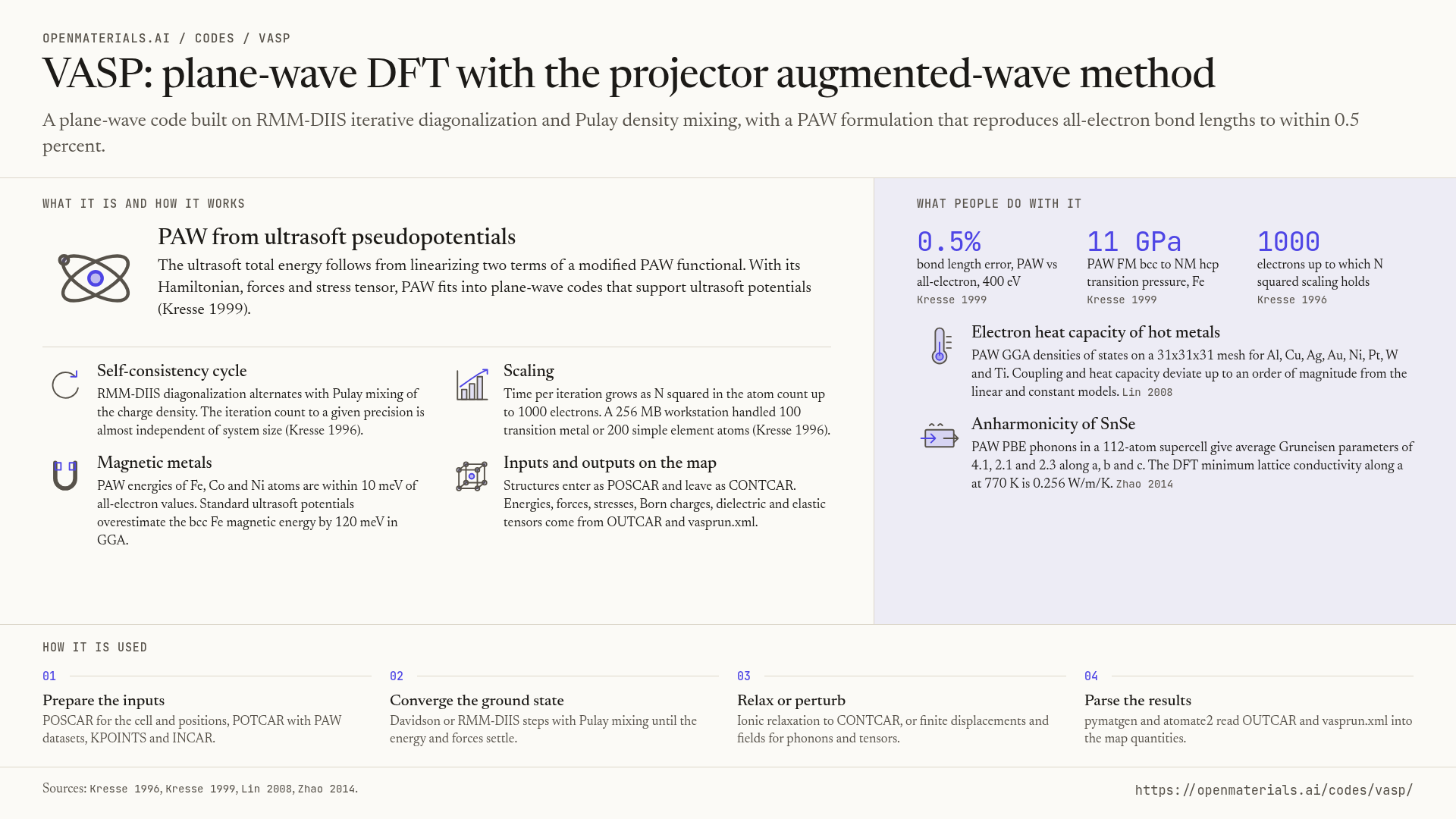
A plane-wave code built on RMM-DIIS iterative diagonalization and Pulay density mixing, with a PAW formulation that reproduces all-electron bond lengths to within 0.5 percent.
What it is and how it works
PAW from ultrasoft pseudopotentials
The ultrasoft total energy follows from linearizing two terms of a modified PAW functional. With its Hamiltonian, forces and stress tensor, PAW fits into plane-wave codes that support ultrasoft potentials (Kresse 1999).
Self-consistency cycle
RMM-DIIS diagonalization alternates with Pulay mixing of the charge density. The iteration count to a given precision is almost independent of system size (Kresse 1996).
Scaling
Time per iteration grows as N squared in the atom count up to 1000 electrons. A 256 MB workstation handled 100 transition metal or 200 simple element atoms (Kresse 1996).
Magnetic metals
PAW energies of Fe, Co and Ni atoms are within 10 meV of all-electron values. Standard ultrasoft potentials overestimate the bcc Fe magnetic energy by 120 meV in GGA.
Inputs and outputs on the map
Structures enter as POSCAR and leave as CONTCAR. Energies, forces, stresses, Born charges, dielectric and elastic tensors come from OUTCAR and vasprun.xml.
What people do with it
- 0.5%bond length error, PAW vs all-electron, 400 eVKresse 1999
- 11 GPaPAW FM bcc to NM hcp transition pressure, FeKresse 1999
- 1000electrons up to which N squared scaling holdsKresse 1996
Electron heat capacity of hot metals
PAW GGA densities of states on a 31x31x31 mesh for Al, Cu, Ag, Au, Ni, Pt, W and Ti. Coupling and heat capacity deviate up to an order of magnitude from the linear and constant models. Lin 2008
Anharmonicity of SnSe
PAW PBE phonons in a 112-atom supercell give average Gruneisen parameters of 4.1, 2.1 and 2.3 along a, b and c. The DFT minimum lattice conductivity along a at 770 K is 0.256 W/m/K. Zhao 2014
How it is used
Prepare the inputs
POSCAR for the cell and positions, POTCAR with PAW datasets, KPOINTS and INCAR.
Converge the ground state
Davidson or RMM-DIIS steps with Pulay mixing until the energy and forces settle.
Relax or perturb
Ionic relaxation to CONTCAR, or finite displacements and fields for phonons and tensors.
Parse the results
pymatgen and atomate2 read OUTCAR and vasprun.xml into the map quantities.
What VASP is
VASP is a plane-wave electronic structure code using the projector augmented-wave method. It computes total energies, forces, stresses, electronic structure and ab initio molecular dynamics, and is licensed commercially. On the map it serves the ground-state quantities it computes.
WebsiteOn the mapAll codesLicense: Proprietary (VASP commercial license, vasp.at)
In more detail
Self-consistency and PAW
VASP solves the Kohn-Sham equations in a plane-wave basis and reaches the ground state through a self-consistency cycle rather than direct minimization of the functional (Kresse 1996). The paper compares blocked Davidson, sequential conjugate-gradient and RMM-DIIS diagonalization and finds RMM-DIIS most efficient for large systems. Pulay's scheme mixes the charge density under a metric and preconditioner designed for plane waves. Core electrons enter through the PAW method, which splits the Hartree energy as pseudopotential plane-wave codes do and includes partial core corrections in the exchange-correlation energy on the plane-wave grid (Kresse 1999).
Numerics and scale
For metals the self-consistency cycle is significantly faster than direct minimization with conjugate gradients, and the number of iterations to a given precision is almost independent of system size (Kresse 1996). Computer time per iteration scales as the square of the number of atoms for systems up to 1000 electrons. In 1996 the program handled up to 100 transition metal atoms or 200 simple element atoms on 256 MB workstations. Cholesky-based Gram-Schmidt orthonormalization ran two to four times faster than the sequential scheme. PAW bond length errors stay below 0.5 percent even for datasets needing less than 400 eV (Kresse 1999).
Validation
Against relaxed-core all-electron results, PAW dimer bond lengths differ by less than 0.1 percent at a 700 eV cutoff, 0.2 percent for F2, and generally by less than 0.5 percent with 400 eV datasets (Kresse 1999). For diamond, Si, V, Ca and CaF2 the lattice constants, bulk moduli and cohesive energies agree with earlier PAW and FLAPW results within 0.5, 5 and 1 percent. In Fe, Co and Ni atoms the PAW interconfigurational and magnetic energies differ from all-electron values by at most 10 meV. The PAW transition pressure from FM bcc to NM hcp Fe is 11 GPa. For the bcc Fe magnetic energy the standard ultrasoft potential is off by 50 meV in the LDA and overestimates it by 120 meV in the GGA.
What it computes on the map
10 quantities, drawn by tier with the data flow between them. Dashed boxes are intermediate quantities. Select one for its formula and the other codes that compute it.
Embed this submap
<iframe src="https://openmaterials.ai/m/c56731602651/0c000000000001f880000002?embed=1" title="VASP on the OpenMaterials map" width="100%" height="480" loading="lazy" style="border:1px solid #EBEBEB;border-radius:6px"></iframe>
Each quantity with the interface the representation records.
- BandGappymatgen BSVasprun.get_band_structure().get_band_gap()['energy'] / Vasprun / TaskDoc, eVev
- BornChargespymatgen Outcar.born (VASP LEPSILON, 'BORN EFFECTIVE CHARGES' section), shape (n_atoms, 3, 3), units of edimensionless
- DielectricTensorpymatgen Outcar.dielectric_tensor (VASP LEPSILON, static clamped-ion 3x3), dimensionlessdimensionless
- ElasticConstantspymatgen Outcar.elastic_modulus (VASP IBRION=6 'TOTAL ELASTIC MODULI (kBar)'), kbar; atomate2 ElasticMakerkbar
- ElectronicDOSpymatgen Vasprun.complete_dos.densities (total DOS), states/eV vs energy grid; efermi from CompleteDosper_ev
- Forcesatomate2 TaskDoc.output.forces; pymatgen Vasprun.forces[-1] (final ionic step), eV/AeV_per_A
- MagneticMomentpymatgen Outcar.magnetization (per site) / Outcar.total_magnetization (cell), mu_B; ISPIN=2 collinearmu_B
- Stressatomate2 TaskDoc.output.stress (emmet OutputDoc, kbar) / pymatgen Vasprun.stress[-1] (kbar)kbar
- StructureVASP POSCAR (input) / CONTCAR (relaxed); atomate2 TaskDoc.structure, pymatgen Vasprun.final_structure
- TotalEnergyatomate2 TaskDoc.output.energy (e_0_energy); pymatgen Vasprun.final_energy, eVev
References
The code
The papers that describe the code; cite them when you use it.
- G. Kresse, J. Furthmüller, Efficiency of ab-initio total energy calculations for metals and semiconductors using a plane-wave basis set, Computational Materials Science, 1996. doi.org/10.1016/0927-0256(96)00008-0
- G. Kresse, J. Furthmüller, Efficient iterative schemes for ab initio total-energy calculations using a plane-wave basis set, Physical Review B, 1996. doi.org/10.1103/PhysRevB.54.11169
- G. Kresse, D. Joubert, From ultrasoft pseudopotentials to the projector augmented-wave method, Physical Review B, 1999. doi.org/10.1103/PhysRevB.59.1758
Applications
Highly cited studies that cite the code, with a few picked by hand.
- Z. Lin, L. V. Zhigilei, V. Celli, Electron-phonon coupling and electron heat capacity of metals under conditions of strong electron-phonon nonequilibrium, Physical Review B, 2008. doi.org/10.1103/PhysRevB.77.075133
- L. D. Zhao, S. H. Lo, Y. Zhang et al., Ultralow thermal conductivity and high thermoelectric figure of merit in SnSe crystals, Nature, 2014. doi.org/10.1038/nature13184
- C. Chang, M. Wu, D. He et al., 3D charge and 2D phonon transports leading to high out-of-plane ZT in n-type SnSe crystals, Science, 2018. doi.org/10.1126/science.aaq1479
How to cite
G. Kresse, J. Furthmuller, Efficient iterative schemes for ab initio total-energy calculations using a plane-wave basis set, Phys. Rev. B 54, 11169 (1996)