openmaterials.ai / codes / xtb
xtb: extended tight-binding for geometries, frequencies and noncovalent interactions
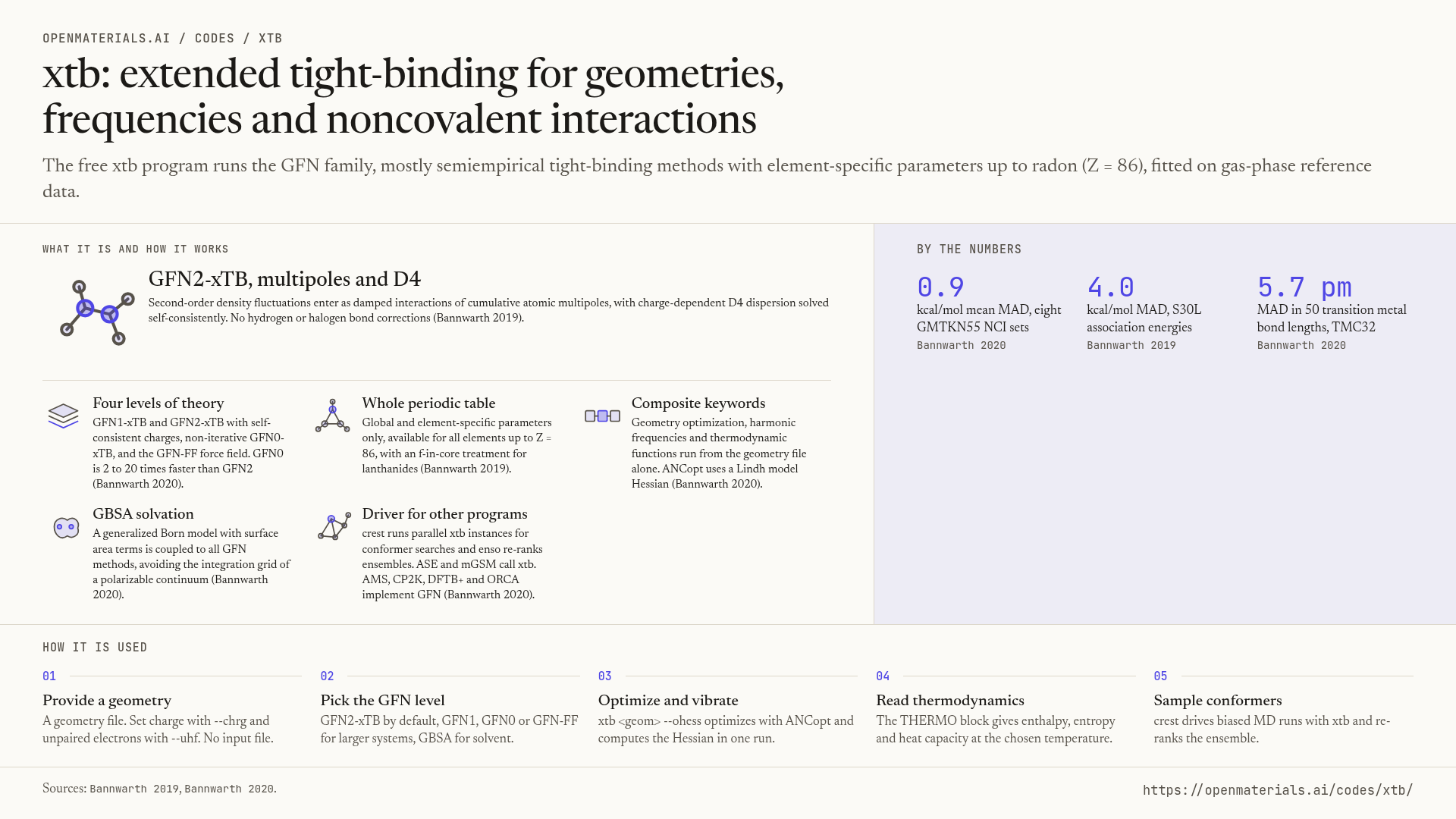
The free xtb program runs the GFN family, mostly semiempirical tight-binding methods with element-specific parameters up to radon (Z = 86), fitted on gas-phase reference data.
What it is and how it works
GFN2-xTB, multipoles and D4
Second-order density fluctuations enter as damped interactions of cumulative atomic multipoles, with charge-dependent D4 dispersion solved self-consistently. No hydrogen or halogen bond corrections (Bannwarth 2019).
Four levels of theory
GFN1-xTB and GFN2-xTB with self-consistent charges, non-iterative GFN0-xTB, and the GFN-FF force field. GFN0 is 2 to 20 times faster than GFN2 (Bannwarth 2020).
Whole periodic table
Global and element-specific parameters only, available for all elements up to Z = 86, with an f-in-core treatment for lanthanides (Bannwarth 2019).
Composite keywords
Geometry optimization, harmonic frequencies and thermodynamic functions run from the geometry file alone. ANCopt uses a Lindh model Hessian (Bannwarth 2020).
GBSA solvation
A generalized Born model with surface area terms is coupled to all GFN methods, avoiding the integration grid of a polarizable continuum (Bannwarth 2020).
Driver for other programs
crest runs parallel xtb instances for conformer searches and enso re-ranks ensembles. ASE and mGSM call xtb. AMS, CP2K, DFTB+ and ORCA implement GFN (Bannwarth 2020).
By the numbers
- 0.9kcal/mol mean MAD, eight GMTKN55 NCI setsBannwarth 2020
- 4.0kcal/mol MAD, S30L association energiesBannwarth 2019
- 5.7 pmMAD in 50 transition metal bond lengths, TMC32Bannwarth 2020
How it is used
Provide a geometry
A geometry file. Set charge with --chrg and unpaired electrons with --uhf. No input file.
Pick the GFN level
GFN2-xTB by default, GFN1, GFN0 or GFN-FF for larger systems, GBSA for solvent.
Optimize and vibrate
xtb <geom> --ohess optimizes with ANCopt and computes the Hessian in one run.
Read thermodynamics
The THERMO block gives enthalpy, entropy and heat capacity at the chosen temperature.
Sample conformers
crest drives biased MD runs with xtb and re-ranks the ensemble.
What xtb is
xtb implements the GFN extended tight-binding methods, GFN2-xTB among them. They give fast energies, geometries, frequencies and properties for molecules and, with GFN0, GFN1 and GFN-FF, periodic systems. On the map it serves the quantities it computes at that level of theory.
WebsiteRepositoryOn the mapAll codesLicense: LGPL-3.0
In more detail
The GFN methods
The xTB energy is a density-functional perturbation expansion in density fluctuations about neutral spherical atoms, with a partially polarized, mostly minimal valence basis. GFN1-xTB keeps terms to third order with monopole electrostatics, D3 dispersion and a halogen bond correction (Bannwarth 2020). GFN2-xTB adds anisotropic second-order terms through damped cumulative atomic multipoles and the self-consistent D4 dispersion model, and needs no hydrogen or halogen bond corrections (Bannwarth 2019). GFN0-xTB drops the charge iterations for a first-order model, and GFN-FF replaces the zeroth-order tight-binding terms with bond, angle and torsion potentials (Bannwarth 2020).
Numerics and scale
The methods target systems of roughly 1000 atoms and run at least two orders of magnitude faster than ab initio methods (Bannwarth 2019). GFNn-xTB scales cubically with atom count and GFN-FF quadratically. On a quad-core desktop, energies and gradients for proteins of 300 to 6000 atoms show GFN0-xTB 2 to 20 times faster than GFN1 and GFN2, and GFN-FF about two further orders of magnitude faster. ANCopt builds normal mode coordinates from a Lindh model Hessian and combines a rational function step with BFGS updates. GFN2-xTB with GBSA relaxes metal-organic polyhedra of 1100 to 1400 atoms in about one hour, and a Pd30L60 polyhedron of almost 2500 atoms in a few days (Bannwarth 2020).
Distribution and interfaces
xtb is published under the LGPL v3 or later on GitHub, with conda-forge and EasyBuild packages and documentation at xtb-docs.readthedocs.io (Bannwarth 2020). Composite keywords cover optimization, harmonic frequencies and thermodynamic functions, so most calculations need only the geometry. xtb drives crest conformer searches, feeds enso for DFT re-ranking with mRRHO and GBSA corrections, and feeds QCEIMS. The GFN methods are also implemented inside AMS, CP2K, DFTB+, entos, ORCA and TeraChem, with interfaces in ASE and Cuby4. On the map xtb serves molar heat capacities from the THERMO block of an --ohess run, and reaction enthalpies from one such run per species.
Validation
ROT34 rotational constants deviate by 1.24 percent (GFN2), 1.10 percent (GFN1) and 2.50 percent (PM6-D3H4X) in SRD (Bannwarth 2019). For the TMC32 set of 50 transition metal bond lengths the MADs are 5.0 pm for GFN1 and 5.7 pm for GFN2, and across the TMG145 complexes bond lengths deviate by 7.5 and 8.3 pm against about 30 pm for PM6 and PM7. GFN2-xTB averages a 0.9 kcal/mol MAD over eight GMTKN55 noncovalent sets, with 0.6 and 0.2 kcal/mol on HEAVY28 and RG18. On S30L GFN2-xTB reaches 4.0 kcal/mol, close to some large basis DFT-D methods. GFNn-xTB is not recommended for accurate covalent reaction energies and barriers (Bannwarth 2020).
What it computes on the map
2 quantities, drawn by tier with the data flow between them. Dashed boxes are intermediate quantities. Select one for its formula and the other codes that compute it.
Embed this submap
<iframe src="https://openmaterials.ai/m/c56731602651/00040000000000000008?embed=1" title="xtb on the OpenMaterials map" width="100%" height="480" loading="lazy" style="border:1px solid #EBEBEB;border-radius:6px"></iframe>
Each quantity with the interface the representation records.
- MolarHeatCapacityxtb <geom> --ohess --temp <T> (THERMO block, Cp row)J_per_K_per_mol
- ReactionEnergyxtb <geom> --ohess --temp 298.15 per species; dH298 = sum(products) - sum(reactants)eV
References
The code
The papers that describe the code; cite them when you use it.
- C. Bannwarth, S. Ehlert, S. Grimme, GFN2-xTB─An Accurate and Broadly Parametrized Self-Consistent Tight-Binding Quantum Chemical Method with Multipole Electrostatics and Density-Dependent Dispersion Contributions, Journal of Chemical Theory and Computation, 2019. doi.org/10.1021/acs.jctc.8b01176
- C. Bannwarth, E. Caldeweyher, S. Ehlert et al., Extended tight‐binding quantum chemistry methods, WIREs Computational Molecular Science, 2020. doi.org/10.1002/wcms.1493
Methods and inputs it builds on
The methods the code implements and the inputs it relies on, as published.
- S. Grimme, Exploration of Chemical Compound, Conformer, and Reaction Space with Meta-Dynamics Simulations Based on Tight-Binding Quantum Chemical Calculations, Journal of Chemical Theory and Computation, 2019. doi.org/10.1021/acs.jctc.9b00143
Applications
No independent study using xtb is on record here yet. The list fills in when one is verified.
How to cite
C. Bannwarth, E. Caldeweyher, S. Ehlert, et al., Extended tight-binding quantum chemistry methods, WIREs Comput. Mol. Sci. 11, e1493 (2020); method: C. Bannwarth, S. Ehlert, S. Grimme, GFN2-xTB, an Accurate and Broadly Parametrized Self-Consistent Tight-Binding Quantum Chemical Method with Multipole Electrostatics and Density-Dependent Dispersion Contributions, J. Chem. Theory Comput. 15, 1652 (2019)