openmaterials.ai / codes / AMSET
AMSET: carrier scattering rates and transport from first principles
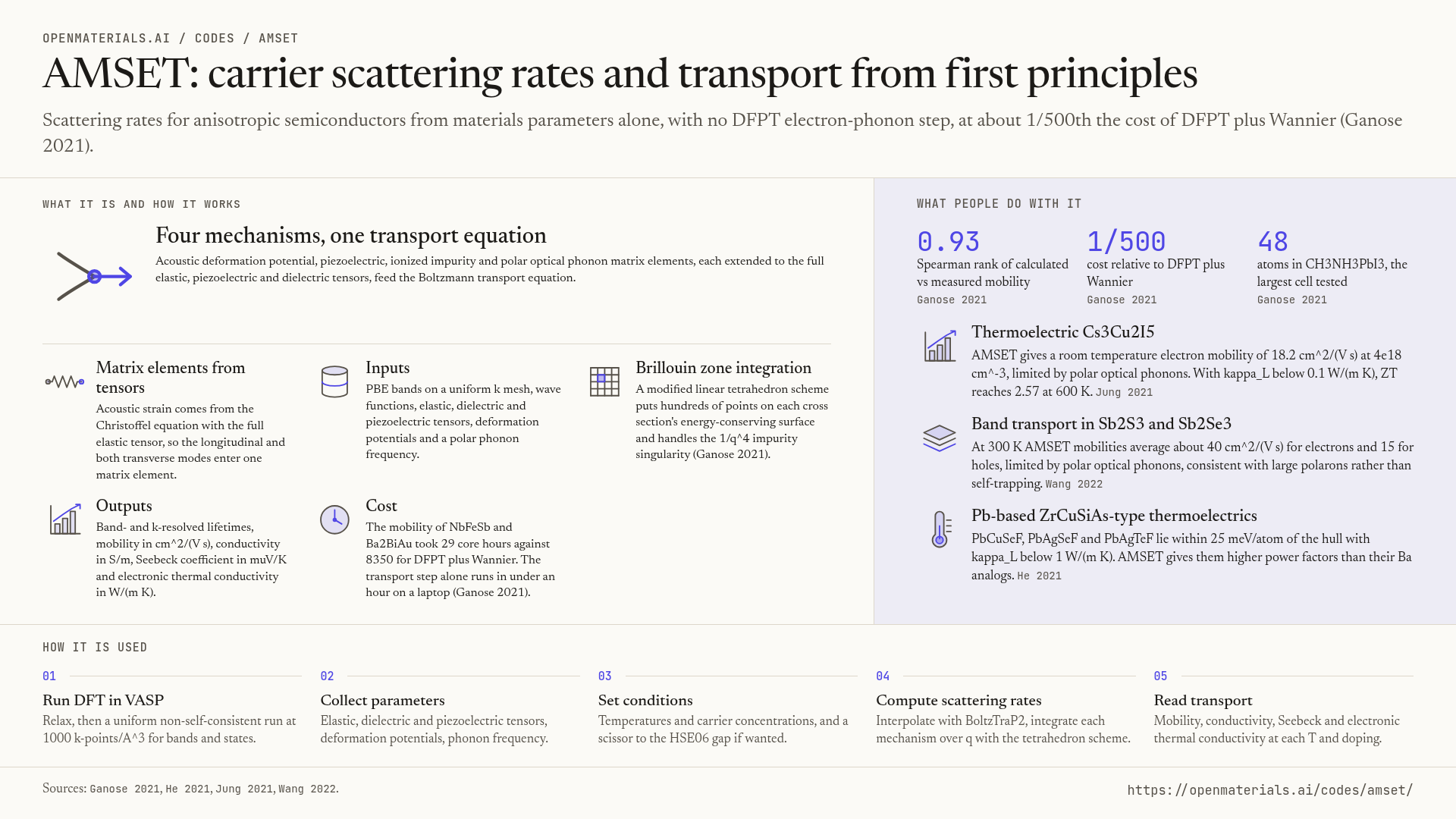
Scattering rates for anisotropic semiconductors from materials parameters alone, with no DFPT electron-phonon step, at about 1/500th the cost of DFPT plus Wannier (Ganose 2021).
What it is and how it works
Four mechanisms, one transport equation
Acoustic deformation potential, piezoelectric, ionized impurity and polar optical phonon matrix elements, each extended to the full elastic, piezoelectric and dielectric tensors, feed the Boltzmann transport equation.
Matrix elements from tensors
Acoustic strain comes from the Christoffel equation with the full elastic tensor, so the longitudinal and both transverse modes enter one matrix element.
Inputs
PBE bands on a uniform k mesh, wave functions, elastic, dielectric and piezoelectric tensors, deformation potentials and a polar phonon frequency.
Brillouin zone integration
A modified linear tetrahedron scheme puts hundreds of points on each cross section's energy-conserving surface and handles the 1/q^4 impurity singularity (Ganose 2021).
Outputs
Band- and k-resolved lifetimes, mobility in cm^2/(V s), conductivity in S/m, Seebeck coefficient in muV/K and electronic thermal conductivity in W/(m K).
Cost
The mobility of NbFeSb and Ba2BiAu took 29 core hours against 8350 for DFPT plus Wannier. The transport step alone runs in under an hour on a laptop (Ganose 2021).
What people do with it
- 0.93Spearman rank of calculated vs measured mobilityGanose 2021
- 1/500cost relative to DFPT plus WannierGanose 2021
- 48atoms in CH3NH3PbI3, the largest cell testedGanose 2021
Thermoelectric Cs3Cu2I5
AMSET gives a room temperature electron mobility of 18.2 cm^2/(V s) at 4e18 cm^-3, limited by polar optical phonons. With kappa_L below 0.1 W/(m K), ZT reaches 2.57 at 600 K. Jung 2021
Band transport in Sb2S3 and Sb2Se3
At 300 K AMSET mobilities average about 40 cm^2/(V s) for electrons and 15 for holes, limited by polar optical phonons, consistent with large polarons rather than self-trapping. Wang 2022
Pb-based ZrCuSiAs-type thermoelectrics
PbCuSeF, PbAgSeF and PbAgTeF lie within 25 meV/atom of the hull with kappa_L below 1 W/(m K). AMSET gives them higher power factors than their Ba analogs. He 2021
How it is used
Run DFT in VASP
Relax, then a uniform non-self-consistent run at 1000 k-points/A^3 for bands and states.
Collect parameters
Elastic, dielectric and piezoelectric tensors, deformation potentials, phonon frequency.
Set conditions
Temperatures and carrier concentrations, and a scissor to the HSE06 gap if wanted.
Compute scattering rates
Interpolate with BoltzTraP2, integrate each mechanism over q with the tetrahedron scheme.
Read transport
Mobility, conductivity, Seebeck and electronic thermal conductivity at each T and doping.
What AMSET is
AMSET computes electronic transport in semiconductors from DFT inputs. It evaluates scattering rates for acoustic and polar optical phonons, ionized impurities and piezoelectric coupling, then solves for mobility, conductivity and Seebeck coefficient as a function of temperature and doping. On the map it serves the electronic transport quantities that depend on those rates.
WebsiteRepositoryOn the mapAll codesLicense: BSD-3-Clause
In more detail
Scattering without DFPT
AMSET writes each mechanism as a Born-approximation matrix element. Acoustic deformation potential scattering joins the Bardeen-Shockley form to the Khan-Allen deformation potential tensor, with each mode's strain from the Christoffel equation and amplitude from kB T over rho c^2. Piezoelectric scattering uses the full piezoelectric stress tensor and all three modes. Polar optical scattering extends the Frohlich model with overlaps, an anisotropic permittivity and one dipole-weighted phonon frequency. Ionized impurities are Coulomb potentials screened by the full dielectric tensor. Elastic rates use the momentum relaxation time approximation, polar rates the self-energy one (Ganose 2021).
Numerics and scale
Eigenvalues and group velocities are Fourier interpolated onto dense grids with BoltzTraP2, and AMSET evaluates scattering only at the most important k-points. A modified linear tetrahedron integration resamples cross sections with hundreds of points that satisfy the delta function exactly and reproduces the Brooks-Herring mobility for parabolic bands. Matrix element cost does not depend on the number of atoms. For NbFeSb and Ba2BiAu the full mobility took 29 core hours against 8350 for DFPT plus Wannier, and ten temperatures for Ba2BiAu under 35 core hours against about 32,000. The transport step for each material ran in under an hour on a laptop (Ganose 2021).
Inputs and interfaces
In the paper the first-principles inputs come from VASP with PBE, managed by atomate. The runs use a 520 eV cutoff, 64 k-points/A^3 for relaxation and 1000 k-points/A^3 for the uniform run. DFPT gives the dielectric and piezoelectric tensors, and stress-strain fits give the elastic constants. A scissor shifts band gaps to HSE06. The Materials Project already holds over 3300 piezoelectric tensors, 7100 dielectric constants and 13,000 elastic tensors. AMSET is a Python package with command-line tools (Ganose 2021). On the map it serves carrier mobility, electrical conductivity, electronic thermal conductivity, Seebeck coefficient and the static dielectric tensor assembled from the DFPT inputs.
Validation
Mode-resolved rates for n-Si and n-GaAs at 300 K match EPW and PERTURBO, including the onset of polar optical emission in GaAs. Across 21 semiconductors from 2 to 48 atoms per cell, calculated mobilities at 300 K span ZnO at 180 cm^2/(V s) to n-GaAs at 2.1e4 cm^2/(V s) with a Spearman rank of 0.93 against experiment, where a 10 fs constant lifetime gives 0.52. The mean squared error of the temperature dependence is 0.20 against 0.19 for DFPT plus Wannier and 3.2 for a constant lifetime. CH3NH3PbI3 agrees with EPW within 5% at all temperatures. AMSET overestimates n-ZnS about 4 times because PBE gives an effective mass of 0.16 against 0.22 measured. HSE06 fixes it (Ganose 2021).
What it computes on the map
5 quantities, drawn by tier with the data flow between them. Dashed boxes are intermediate quantities. Select one for its formula and the other codes that compute it.
Embed this submap
<iframe src="https://openmaterials.ai/m/c56731602651/000000000000000000000005e0?embed=1" title="AMSET on the OpenMaterials map" width="100%" height="480" loading="lazy" style="border:1px solid #EBEBEB;border-radius:6px"></iframe>
Each quantity with the interface the representation records.
- CarrierMobilityamset.core.run mobility, cm^2/(V s) (transport.py:133-135; run.py:583,617 header 'mu [cm^2/Vs]')cm2_per_v_s
- ElectricalConductivity[carrier=electronic]amset.core.data.to_data cond, S/m (data.py:484); run.py:583 header 'sigma [S/m]'s_per_m
- ElectronicThermalConductivityamset.core.data.to_data kappa, header unit '?' (data.py:483-484); electronic_thermal_conductivity field (data.py:80)W_per_m_per_K
- SeebeckCoefficientamset.core.data.to_data seebeck, muV/K (data.py:484; transport.py:191 *1e6); run.py:583 header 'S [muV/K]'muv_per_k
- StaticDielectricTensoratomate2 VaspAmsetMaker static+dielectric outputs assembled to eps_0 = eps_inf + ionic (vasp/flows/amset.py:261-266); amset settings static_dielectricdimensionless
References
The code
The papers that describe the code; cite them when you use it.
- A. M. Ganose, J. Park, A. Faghaninia et al., Efficient calculation of carrier scattering rates from first principles, Nature Communications, 2021. doi.org/10.1038/s41467-021-22440-5
Applications
Highly cited studies that cite the code, with a few picked by hand.
- J. He, Y. Xia, W. Lin et al., Accelerated Discovery and Design of Ultralow Lattice Thermal Conductivity Materials Using Chemical Bonding Principles, Advanced Functional Materials, 2021. doi.org/10.1002/adfm.202108532
- Y. K. Jung, I. T. Han, Y. C. Kim et al., Prediction of high thermoelectric performance in the low-dimensional metal halide Cs3Cu2I5, npj Computational Materials, 2021. doi.org/10.1038/s41524-021-00521-9
- X. Wang, A. M. Ganose, S. R. Kavanagh et al., Band versus Polaron: Charge Transport in Antimony Chalcogenides, ACS Energy Letters, 2022. doi.org/10.1021/acsenergylett.2c01464
How to cite
A. M. Ganose, J. Park, A. Faghaninia, R. Woods-Robinson, K. A. Persson, A. Jain, Efficient calculation of carrier scattering rates from first principles, Nat. Commun. 12, 2222 (2021)